a working system · built for your business · owned by you
A lead‑answering system we build for your business.
One owner-run production test produced a specific, context-aware answer in 16.984 seconds. The public app is deployed; live AI replies require the owner’s answering computer, and no reply time is promised.
Market evidence says the first business to answer often wins the job. There is no in-app subscription or checkout; invited tests use an owner-funded budget before a tailored build is discussed.
from confirmed business context · owner's answering computer required
asks only what the lead hasn't already said
qualified leads can reserve a Leadline slot; calendar email is a separate queued step
hot verdicts prepare an owner email alert
02 · how you get it
Not a subscription. A build, proven first.
Watch it run
On this page: one anonymized recorded path, plus the product's real screens.
Ask for a test run
The form saves your request and shows direct ways to reach Danylo — no checkout.
Test it on your own leads
You get an invite and a test budget we fund. No card, no trial clock.
Own the build
If the test fits, scope a tailored build around your rules and systems.
03 · see it work
Watch a recorded lead reach its routing decision.
This anonymized production test run replays the selected narrative events, including the AI’s reasoning. It ends at queued for human handoff; it does not invent a booking.
1 · Lead arrives
2 · Specific AI answer
3 · The AI reasons + asks
4 · Score + verdict
5 · Queued for human handoff
recorded production test run from 2026-07-17 — anonymized; no real prospect or client data. The on-stage clock shows the true elapsed times from its logged events.
04 · the speed gap
One owner-run test answer took 16.984 seconds.
logarithmic time scale — every stop is honest; the gap really is that wide
78% of buyers purchase from the first responder.
answering within 5 minutes ≈ up to 9× more conversions.
+67% after-hours bookings in a published instant-response case.
external market evidence captured 2026-07-05, not Leadline results — figures may have changed; sources in the competitor teardown
05 · what it does
Six built parts, with evidence limits shown.
The recorded run above demonstrates its answer, score, and handoff decision. Booking, email delivery, and other branches are built but were not rerun in the latest proof. Client calendar and customer-record connections are scoped to that build.
- demonstratedanswers
Context-aware answer
Answers from the business's confirmed context and logs the real arrival-to-answer time. The owner's answering computer must be online.
for: Any business that loses jobs to whoever answers first.
16.984 s · one measured owner-run test - built · latest check pendingqualifies
Qualification conversation
Asks the few questions that matter — budget, scope, timing, area — and only what the lead hasn't already said, across multiple turns.
for: Owners tired of chasing details by phone.
up to two optional follow-ups · always disclosed as automated - built · latest check pendingalerts
Scoring + hot-lead alarm
Every lead is scored against your definition of a good one. A hot result prepares an email alert for the owner.
for: Teams that must never miss the big job.
score · verdict · reasoning · owner email prepared - built · latest check pendingbooks
Calendar booking
Qualified leads pick from available time slots; Leadline reserves one without double-booking and queues a calendar email. The hold does not prove inbox delivery.
for: Anyone whose calendar is the business.
Leadline hold saved · calendar email queued - demonstrated
Owner dashboard
Answer time, leads handled, outcomes, bookings, and estimated compute value — numbers you read in one glance.
for: The owner who wants proof, not promises.
every number derived from logged timestamps - demonstrated
Leadline audit record
Messages, decisions, scores, and timestamps stored inside Leadline are inspectable. Email and calendar delivery confirmation has separate limits.
for: Businesses that need accountability.
+0.000s arrived · +16.984s AI answer · one owner-run test
07 · which AI models
The models used here are named. A client build can use others.
Models used here. Lead conversations use Claude Sonnet. Setup and analysis use Claude Opus on the owner's answering computer. The owner pays for the subscription; visitors do not receive per-call bills. The three cards below are choices for a tailored build, not three models simultaneously serving this site.
Lower-cost compatible AI model
running costdepends on the chosen service
A lower-cost compatible model chosen for the client's workload. It is an option for a tailored build, not a model serving this site.
Claude Opus
running costscoped after volume is known
Claude Opus can be used in a tailored build. Its real cost depends on confirmed lead volume and the work each answer must do.
Model on client-controlled computers
running costhardware and support scoped per build
Not active here. Where the data is processed, what hardware is needed, and who operates it are agreed for that client build.
08 · your math
Estimate your current response workload.
Enter your lead volume and team time. The workload result uses only those inputs; the answer-time line is one owner-run test, not a return or savings promise.
Revenue is yours to compute: we don’t invent your close rate. Bring it, and we’ll do the math with you against the market evidence.
09 · try it live
Try the live intake. The AI answer needs the owner’s computer.
No demo account — this form writes to the deployed intake immediately. A specific, reasoned answer waits for the owner’s answering computer; if it is offline, the saved request waits. No response-time promise is made.
10 · the real screens
These are the product’s own screens.
A landing page can claim anything. Here are the screens the system actually runs — and two of them you can open right now.
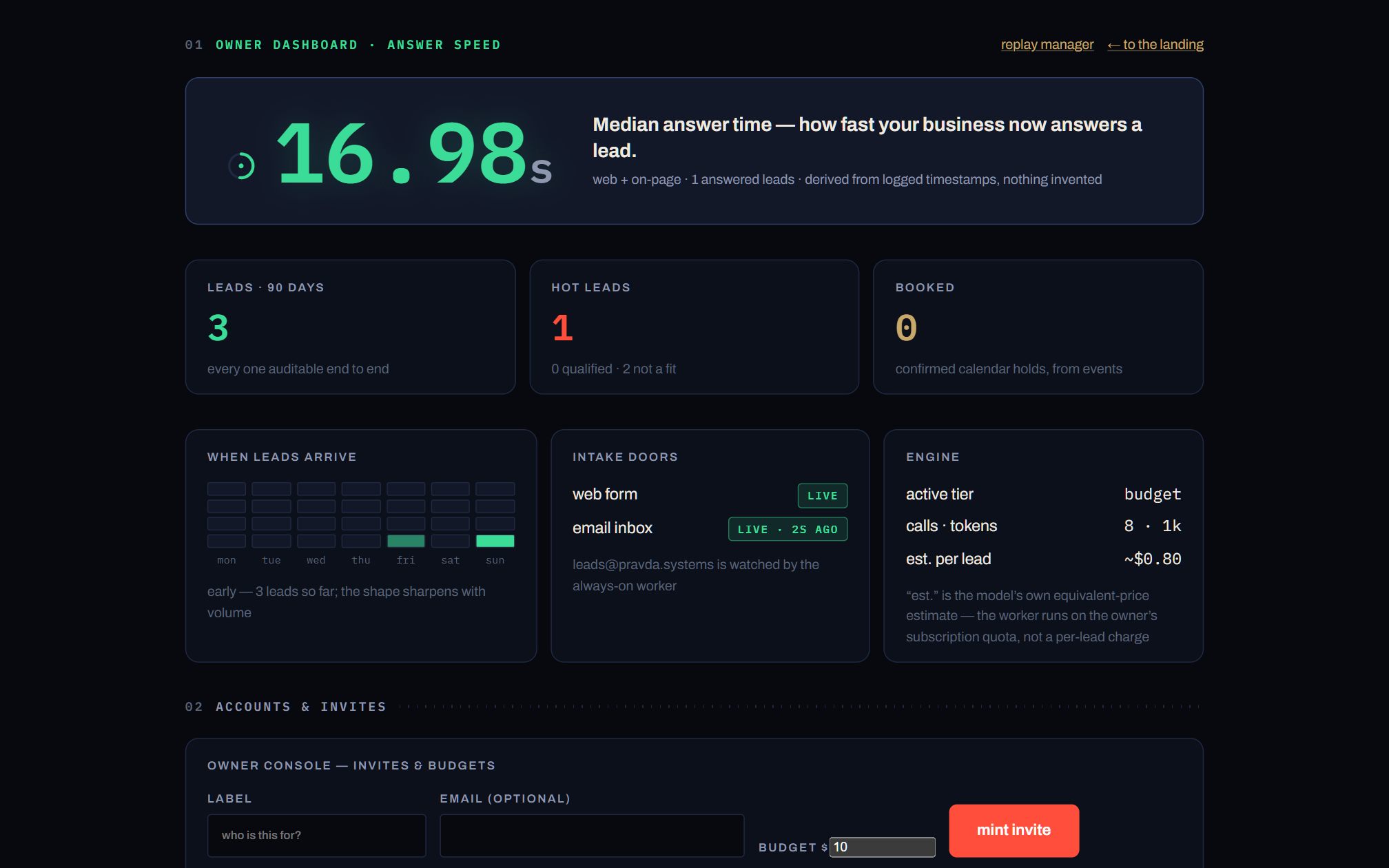
The owner dashboard
Answer times, outcomes, bookings, cost per lead — every number derived from logged events. An owner-only screen, shown here as a capture.
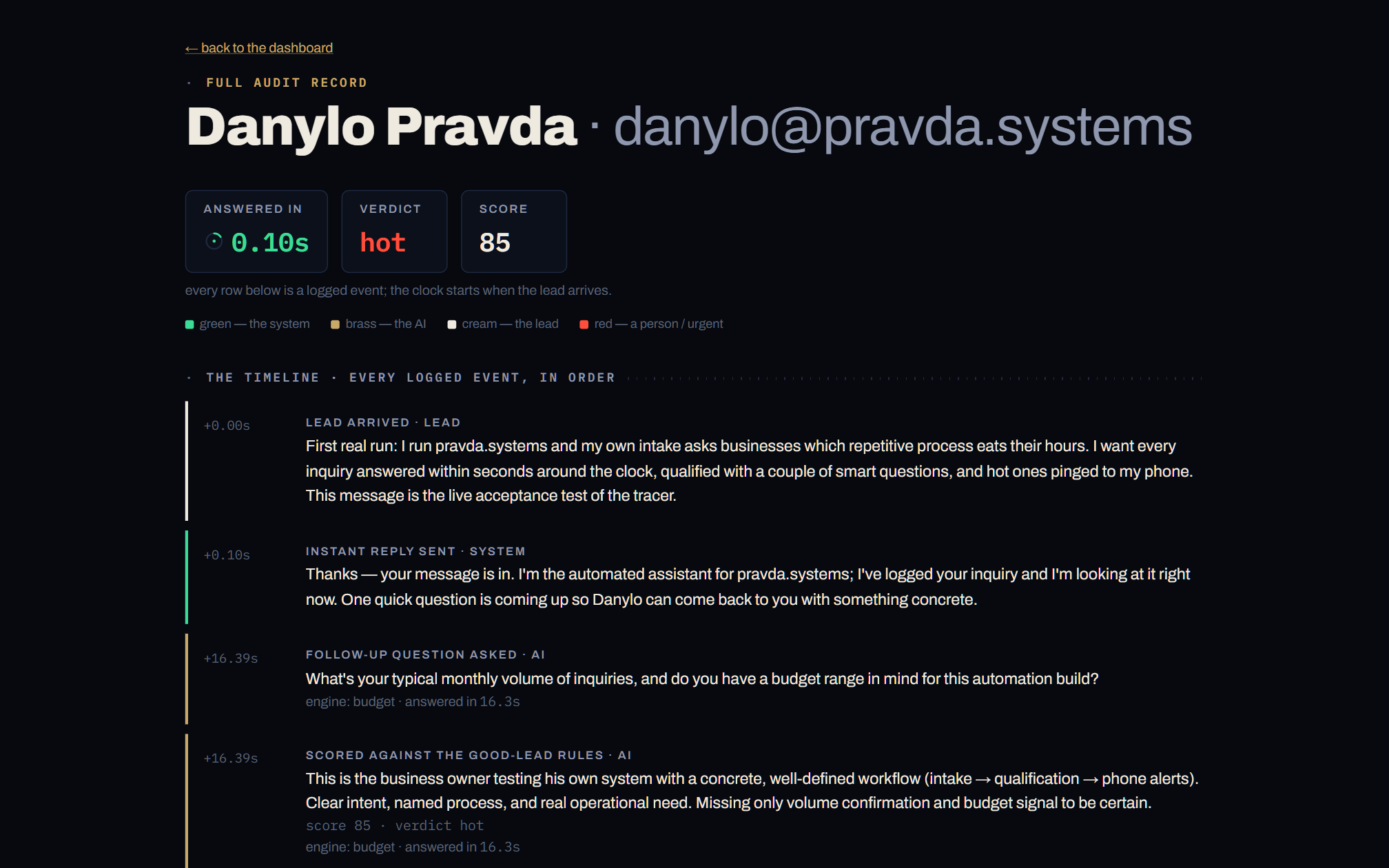
One lead’s Leadline record
The messages, decisions, score, and timestamps stored in Leadline. External delivery confirmation has separate limits. See the audit evidence →
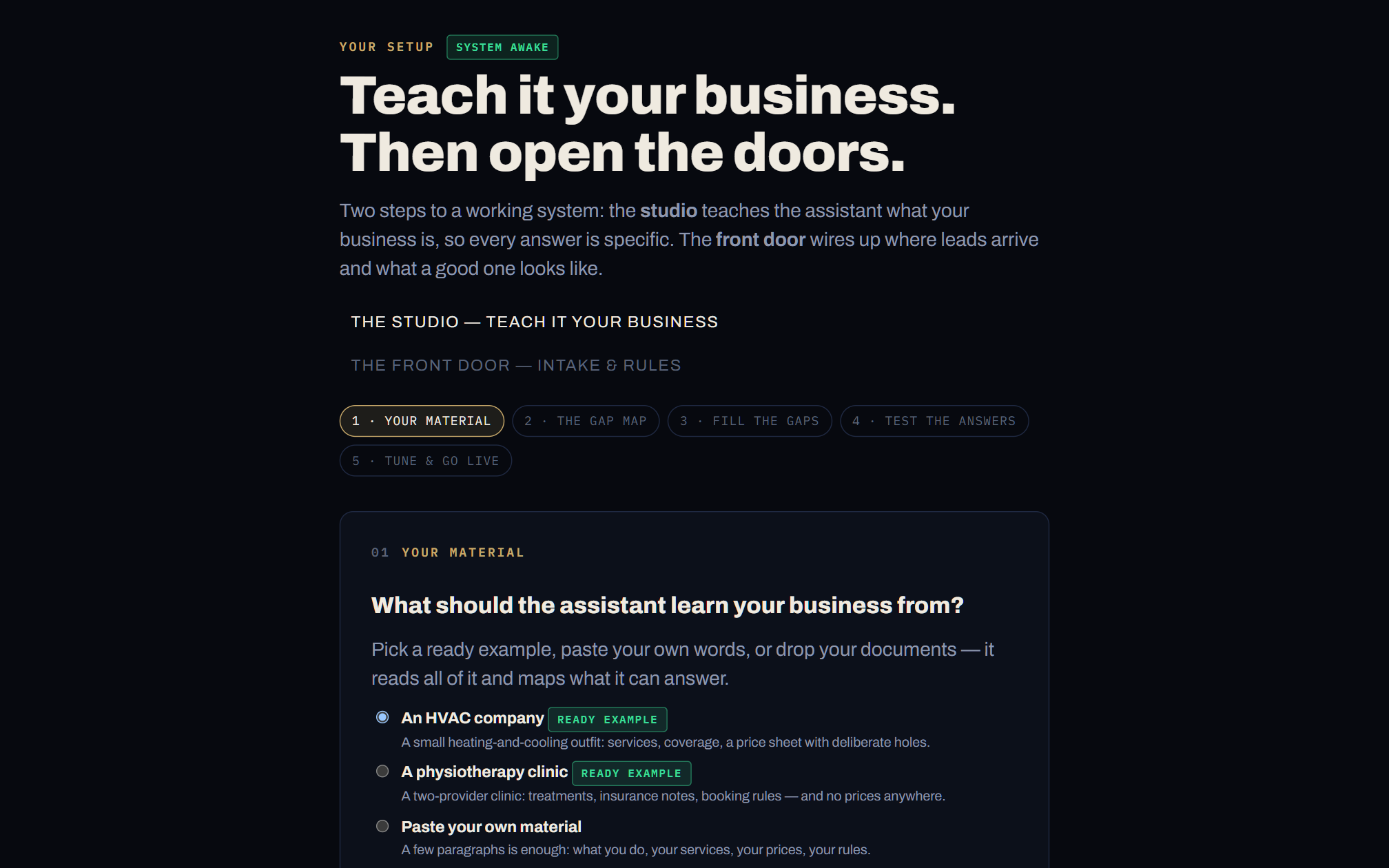
The setup, in plain words
You describe your business; it proposes the questions and rules; nothing runs until you confirm. See it as a session →
The volume view
Every dot is a lead being handled: leads become conversations, conversations become decisions, some become bookings.
6 leads · 0 conversations · 6 decisions · 0 bookings — last 30 days, measured
11 · how we compare
What our 2026-07-05 signup snapshot found.
From our first-hand teardown (we signed up, clicked through, and hit every wall). Pricing and product scope may have changed since this dated snapshot.
12 · why own it
A rented tool never becomes your system.
It can be fitted to your workflow
The current core uses Leadline’s own schedule and prepares a calendar invitation. Direct calendar synchronization and customer-record sync are not built core.
Speed is the whole edge
The dated market evidence favors fast replies. Leadline logs the real answer time; one owner-run test answer took 16.984 seconds, with no promised reply time.
Your rules become yours
Your confirmed definition of a good lead lives in the business profile and can be edited in Studio. There is no hidden automatic-learning claim.
13 · next step
Get this built for your business.
There is no checkout anywhere in this product, deliberately. The form below is the next step — it saves into this same system and includes direct contact channels. No follow-up time is promised.
get it built — free test run
This form saves to Leadline immediately. The owner’s answering computer produces the AI answer when available; the request waits while that computer is offline.
If the test fits, Danylo scopes a version around your business. Calendar and customer-record connections are part of that tailored work, not shipped core here.
You get $10 of test usage on our infrastructure first — on our prepared data or your own. Invite codes come from Danylo.